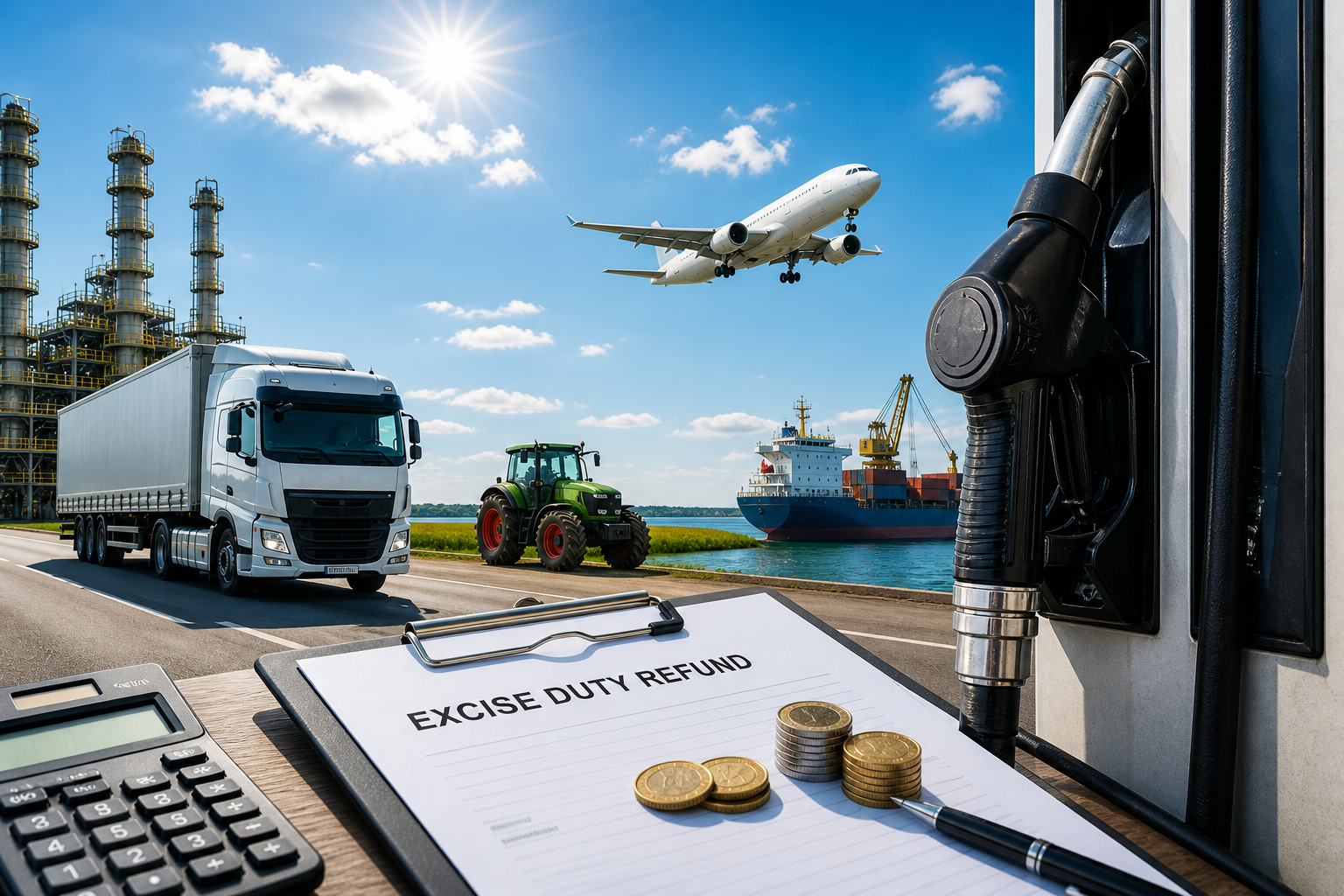
Spain: Refunds of the Excise Duty on Hydrocarbons — a practical guide
The Excise Duty on Hydrocarbons is one of those taxes that most people pay without really noticing. It’s built into the price of fuel, so it often goes unquestioned. What is less widely known, however, is that in certain situations the law allows taxpayers to recover part — or even all — of the duty paid. These refunds are not uniform: they respond to different policy goals and each comes with its own set of conditions.
This article aims to give a practical overview — without getting overly technical — of the main refund mechanisms currently available in Spain, focusing on when they apply, who can benefit from them and what needs to be done in practice.
Probably the most familiar scheme is the refund for professional diesel. Its purpose is straightforward: to ease the tax burden on sectors that rely heavily on fuel consumption. This includes, for example, businesses operating road haulage vehicles with a maximum authorised mass of at least 7.5 tonnes. It also covers passenger transport services — such as buses, taxis or ride-hailing vehicles — provided the activity is carried out on a professional basis.
Not all fuel qualifies. The diesel must be standard fuel used in eligible vehicles, and it has to be purchased at service stations using authorised electronic means of payment. In practice, this means that beneficiaries must be registered in the relevant census, use specific fuel cards and ensure that their vehicles meet the required technical criteria. The refund itself is calculated automatically based on consumption and is typically paid on a regular basis — usually monthly — without the need to submit repeated claims.
Another important area is diesel used in agricultural, livestock and forestry activities. Here, the system reflects the essential nature of these sectors. Beneficiaries are generally the operators of such activities who use agricultural machinery or special vehicles, which are often not allowed on public roads.
In these cases, the fuel involved is usually “rebated diesel” (gas oil B), which already benefits from a reduced rate. Even so, additional refunds may still be available. Accessing them requires, among other things, proving one’s status as a farmer or livestock operator, ensuring that the fuel is used exclusively for the relevant activity and complying with the established supply controls. Depending on the setup, the benefit may be obtained directly through the supply itself or through a subsequent refund claim supported by evidence of actual consumption.
Refunds also play a role in maritime and aviation activities. Fuel used in commercial shipping or professional fishing may qualify, whereas private or recreational use is excluded. A similar approach applies in aviation: fuel used for commercial operations or international flights is typically exempt or refundable. In all these cases, the key factor is being able to demonstrate that the fuel has been used solely for the qualifying activity, which in turn requires robust administrative controls and proper documentation.
The rules also distinguish between fuel used for propulsion and fuel used for other purposes, such as heating or industrial processes. When hydrocarbons are not used as motor fuel, refunds may arise in situations like their use in manufacturing processes or as raw materials in certain chemical operations. These cases tend to involve stricter oversight, including authorised facilities, stock monitoring systems and a clear audit trail showing how the products have actually been used.
Then there are the more straightforward situations where the tax should never have been paid in the first place. This might happen due to invoicing errors, the application of an incorrect rate or even double taxation somewhere along the supply chain. In such cases, the refund must be claimed through the procedure for undue payments. This involves submitting a formal request, proving that the payment was incorrect and showing that no unjust enrichment has occurred.
In practice, making the most of these refund mechanisms is not just about meeting the substantive requirements. Administrative discipline plays a crucial role: being properly registered, using authorised payment methods, regularly checking one’s status and — perhaps most importantly — keeping thorough supporting documentation.
Ultimately, refunds of the Excise Duty on Hydrocarbons can represent a significant cost saving, but they are neither automatic nor guaranteed. They require attention to detail and a proactive approach. Those who manage them properly tend to benefit; those who do not may simply be leaving money on the table.