Canned cocktails, ready-to-drink drinks, and alcoholic energy drinks: these products are experiencing rapid growth in the French market, and many operators are unaware that they may be subject to a specific tax , separate from the standard excise tax on alcoholic beverages—the so-called "premix" tax, stipulated in Article 1613 bis of the French General Tax Code (CGI).
This article reviews the two branches of this tax, the actual timeline of its latest expansion, and the most practical questions for operators: who is liable for it, when, and how to prove it in the event of an audit.
Do you produce, import or distribute premixed drinks or RTDs?
Whether you are a manufacturer, importer or reseller, the qualification of your products with regard to the premix tax determines your reporting compliance and your exposure in the event of an inspection.
What is the "premix" tax?
The "premix" tax, codified in Article 1613 bis of the French General Tax Code (CGI ), has historically targeted premixed beverages combining an alcoholic base (spirits, wine, beer) with an ingredient that facilitates consumption—sugar, flavoring, or, more recently, a stimulant. Its stated objective is to limit the consumption of products that mask the actual alcohol content perceived by the consumer, particularly younger consumers.
The key point to remember is that the tax is not triggered by a single criterion, but by two sets of alternative criteria , codified in the same article but corresponding to two distinct rationales. Only one of these criteria is sufficient to make a product taxable.
The two branches of the premix tax
Branch 1: the "classic" premix (alcohol + sugar)
This branch, the oldest, applies to beverages that combine:
an alcohol content between 1.2% and 12% vol .;
a sugar content exceeding 35 grams per litre (or a sweetener with equivalent effect).
Both criteria must be met. The reference customs doctrine on this branch is the circular of July 31, 2025 (DGDDI, BOD n° 7593), in force since that same date.
Branch 2: the "stimulant" premix (new)
A second branch, inserted by Law No. 2025-1403 of December 30, 2025, on financing social security for 2026 (Article 34, creating a new paragraph I bis in Article 1613 bis of the French General Tax Code), applies to beverages that combine:
an alcohol content exceeding 1.2% vol., with no upper limit ;
the presence of a substance having a stimulating effect on the body , regardless of the sugar content.
This category is broader than the first in terms of alcohol content (no 12% cap) and does not require any sugar threshold . A spirit at 18% ABV with added caffeine can therefore fall under this category, whereas it would not be included in the "sugar" category.
Is the list of stimulant substances exhaustive?
Yes. The decree of June 25, 2026 (published in the Official Journal of July 17, 2026), issued for the application of paragraph I bis of Article 1613 bis of the French General Tax Code, establishes the list of substances concerned in a closed manner , without a clause "in particular":
Caffeine
Guaranine
Taurine
Ginseng
Important note : the law itself used the term "notably" before referring to a decree. It is this decree that "establishes" the legally binding list, and it did so in a restrictive manner. As the texts currently stand, a stimulant substance not listed (glucuronolactone, L-theanine, ginkgo biloba, etc.) therefore does not fall within the scope of this branch.
Timeline: When did each text come into effect?
The actual chronology of this reform deserves to be detailed, as it reveals a significant gap between the legal principle and the tools available to comply with it:
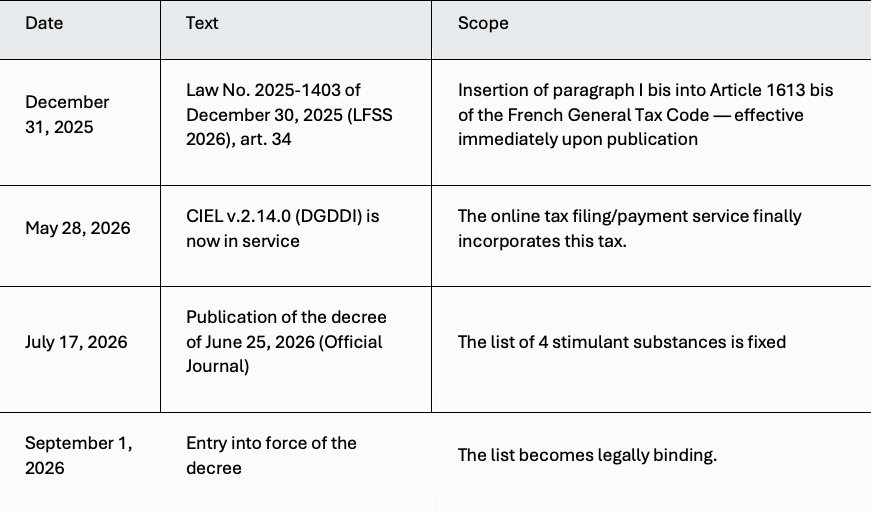
Between December 31, 2025 and September 1, 2026, the principle of taxation was therefore legally in force, without operators having either a complete reporting tool (until May 2026), or an enforceable list of the substances concerned (until July 2026, for application in September).
Who is liable for the tax?
Article 1613 bis (III) of the French General Tax Code (CGI) does not establish its own rules for determining liability: it refers to the rules applicable to excise duty on alcoholic beverages (Code of Taxes on Goods and Services, CIBS, art. L.311-26 et seq.). Liability depends on the taxable event.
Production or importation into the territory: the producer or the importer.
Release from a suspensive regime (tax warehouse): the authorized warehousekeeper who ships.
Receipt in France of a product already placed on the market in another Member State: the registered consignee, the certified consignee, or the tax representative.
Possession or storage without suspension , without proof that the excise has been paid in France or elsewhere in the European Union: the person who holds the products — potentially the buyer-reseller himself.
Due date: when does the tax become payable?
The tax becomes payable upon " release for consumption " (CIBS, art. L.311-12 and L.311-15) — the first of the following events to occur: irregular release outside of a suspension regime, release from the suspension regime, or possession/storage outside of a suspension regime without excise duty paid anywhere in the European Union.
It is important to note that the premix tax is a single-phase tax — it is due only once, at this stage. Once paid, the product then circulates "duty paid" and should not be retaxed, provided that its tax status is properly tracked throughout the supply chain.
Traceability: how to prove that the tax has been paid?
This is the most concrete point for a buyer-reseller who is not himself the originator of the release for consumption.
The authoritative document
Since Decree No. 2025-590 of June 27, 2025 (Official Journal of June 29, 2025, in force since June 30, 2025), the national movement of duty-paid alcoholic beverages between professionals no longer requires a separate administrative form such as the paper DSA . A simple invoice or any other commercial document is sufficient, provided it includes:
the identity of the sender, the recipient and the carrier;
the nature and quantity of the products;
the date the document was established;
a unique reference number to identify the movement in the sender's commercial records.
This decree repealed the previous system (articles 111 H bis et seq. of Appendix III of the French General Tax Code), which gave the impression of a mandatory "simplified accompanying document" (DSA) for goods circulating within France. The tax stamp (the "Marianne") does exist, but it currently only applies to the wine sector—it is not an available alternative for premixed spirits. For these products, the invoice (or equivalent commercial document) correctly annotated, or the DSA, serves as proof.
These documents must be kept by both the sender and the recipient under the conditions stipulated in Article L.102 B of the French Tax Procedures Code .
The risk in the absence of evidence
Without a properly annotated invoice, an inspection may reclassify the possession of the products as a new release for consumption . In this case, the holder becomes liable for the tax—if they are unable to prove that it has already been paid by a previous link in the chain. The burden of proof rests with the person in possession of the goods at the time of the inspection.
🖋️ Remember : always require an invoice from your suppliers that includes the four items mentioned above or the DSA (Document Support Agreement), and keep it with your purchasing records. Ideally, the amount of excise duty and premix tax paid should be indicated.
How is the tax declared?
The premix tax is declared and paid via the CIEL (Online Indirect Contributions) online service, as part of the monthly summary declaration of transactions (DRM). For the "stimulants" branch, this payment is only possible since version 2.14.0 of CIEL, which went live on May 28, 2026 — nearly five months after the legal entry into force of the taxation principle.
Operational points of vigilance
A product may be subject to tax under only one of the two categories: it is not necessary to combine alcohol + sugar + stimulant.
The list of stimulant substances is closed: check the exact composition of your products rather than relying on the commercial category (“energy drink”, “RTD”…).
The customs doctrine available to date (circular of July 31, 2025) documents the "sugar" category; it predates the creation of the "stimulants" category and does not explicitly cover it. Direct verification with the French Customs and Indirect Tax Authority (DGDDI) remains recommended for any borderline cases.
Demand documentary proof of "duties paid" status from your suppliers for each receipt, not just a standard invoice.
Properly classifying your products with regard to both branches of the premix tax, securing your traceability documentation, and anticipating changes in regulations are essential to avoid any risk of tax adjustments.